
Agricultural land drainage in the UK has played an important role in British farming for generations. Productive agriculture across the country depends upon the ability to remove surplus water from the soil efficiently, particularly during the wetter autumn and winter months.
A well-designed agricultural land drainage system does considerably more than remove visible standing water. Effective drainage improves soil conditions, increases opportunities for timely fieldwork, supports more consistent crop establishment and helps protect soil structure during periods of prolonged rainfall.
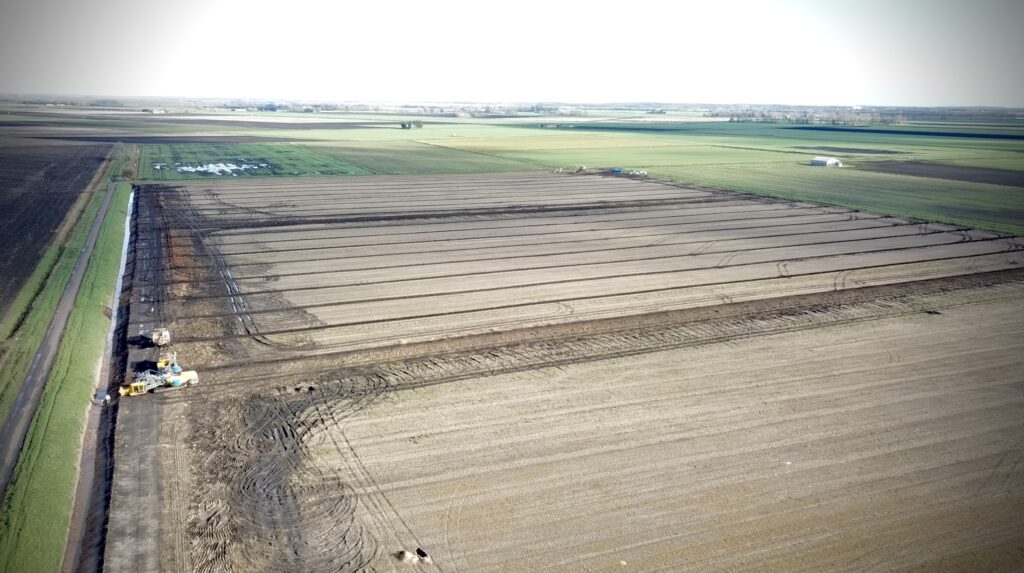
At William Morfoot Ltd, we have specialised in agricultural land drainage and water management since 1962. Over more than six decades, the technology used to survey, design and install drainage systems has changed considerably, but the fundamental objective remains the same: to manage excess water effectively and create better conditions for productive farming.
This guide explains how agricultural land drainage in the UK works, why it matters and what farmers and landowners should consider when investing in a drainage scheme.
What is agricultural land drainage in the UK?
Agricultural land drainage is the controlled removal of excess water from the soil through a network of underground pipes and associated drainage infrastructure.
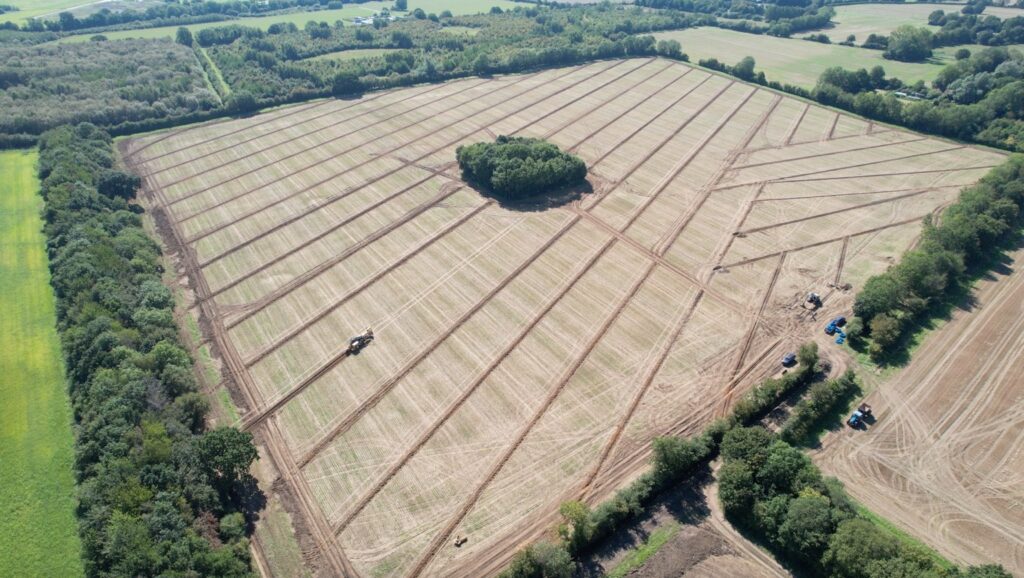
In a typical system, perforated lateral drains are installed across a field at predetermined spacings. These laterals collect water from the surrounding soil and discharge into larger carrier or main drains, which subsequently convey the water towards a suitable outfall such as a ditch or watercourse.
The precise layout depends upon many factors including:
- Soil type and permeability
- Field levels and topography
- Existing drainage infrastructure
- Location and level of available outfalls
- Field size and shape
- Proposed cropping and agricultural use
- The depth and condition of any existing drainage system
There is therefore no single drainage specification that is appropriate for every field.
Why is agricultural land drainage in the UK important?
This is one of the key reasons agricultural land drainage in the UK matters so much: the UK’s climate means that agricultural soils routinely experience periods when rainfall exceeds the amount of water that can be used by crops or lost through evaporation.
Once the soil becomes saturated, surplus water needs somewhere to go.
Without effective drainage, soils can remain waterlogged for prolonged periods – which in turn can increase run off levels at surface level. This reduces the amount of oxygen available within the soil and can adversely affect crop roots, nutrient uptake and biological activity.
Poorly drained land can also create significant practical problems for farming businesses.
Drilling, spraying, fertiliser application and harvesting all depend upon being able to travel on the land at the appropriate time. Even relatively short delays can have considerable consequences during narrow operational windows.
Effective land drainage helps fields return to workable conditions more quickly following rainfall, giving farmers greater flexibility when making agronomic and operational decisions.
The importance of soil structure
An underground drainage pipe can only remove water that reaches it. Underground pipes will only carry water when the soils are at field capacity.
Field capacity is the amount of water a soil can naturally hold after excess water has drained away under gravity.
The best way to explain field capacity is to think of soil like a sponge. After heavy rain:
The soil initially becomes saturated, with virtually all its pore spaces filled with water.
Gravity then pulls the excess water down through the soil and into drains or groundwater.
Once this excess has drained away, the water remaining within the soil is held by the soil particles. This point is called field capacity.
Effective land drainage is closely connected with soil structure in that saturated un-aerobic soils tend to have poor, low quality soil structures – meaning that crops will struggle to grow effectively.
Healthy soils contain pores, fissures and natural pathways through which water can move. Where these pathways become restricted by compaction or structural damage, water movement towards the drainage system can be significantly reduced.
This is why a professional drainage assessment should look beyond the presence or absence of standing water.
Understanding the soil profile, identifying restrictive layers and considering how water moves vertically and horizontally through the field are all important parts of developing an effective drainage strategy.
On some soil types, secondary drainage techniques such as moling can be used alongside underground pipe systems to improve the movement of water towards the drains.
Survey and design: the foundation of a successful drainage scheme
The quality of an agricultural land drainage system begins with the survey and design process.
Historically, drainage systems were commonly installed using considerably more basic surveying techniques. Modern GPS surveying and digital mapping now allow fields to be assessed with a much greater degree of accuracy.
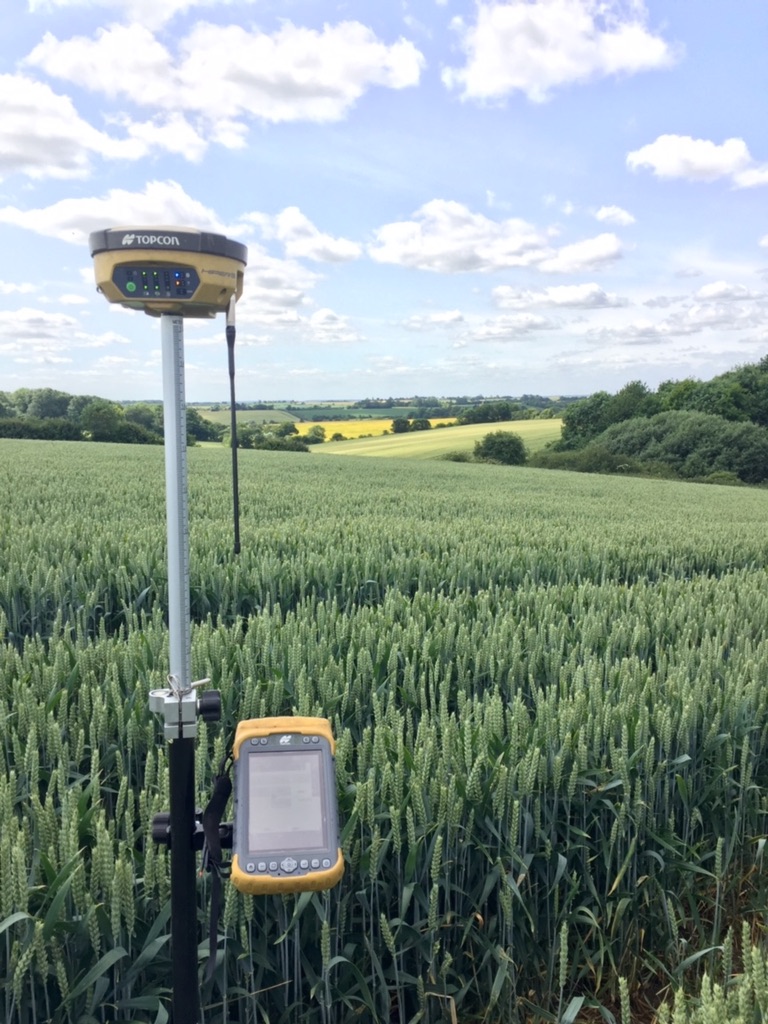
At William Morfoot Ltd, we use modern surveying equipment to record field levels and understand how they relate to existing drains, ditches and other outfalls.
This information can then be used to develop a detailed drainage design.
Correct levels and gradients are essential. Water needs to move efficiently through the system while drain depths must also take account of field conditions, existing infrastructure and the requirements of modern agriculture.
How is an agricultural drainage system installed?
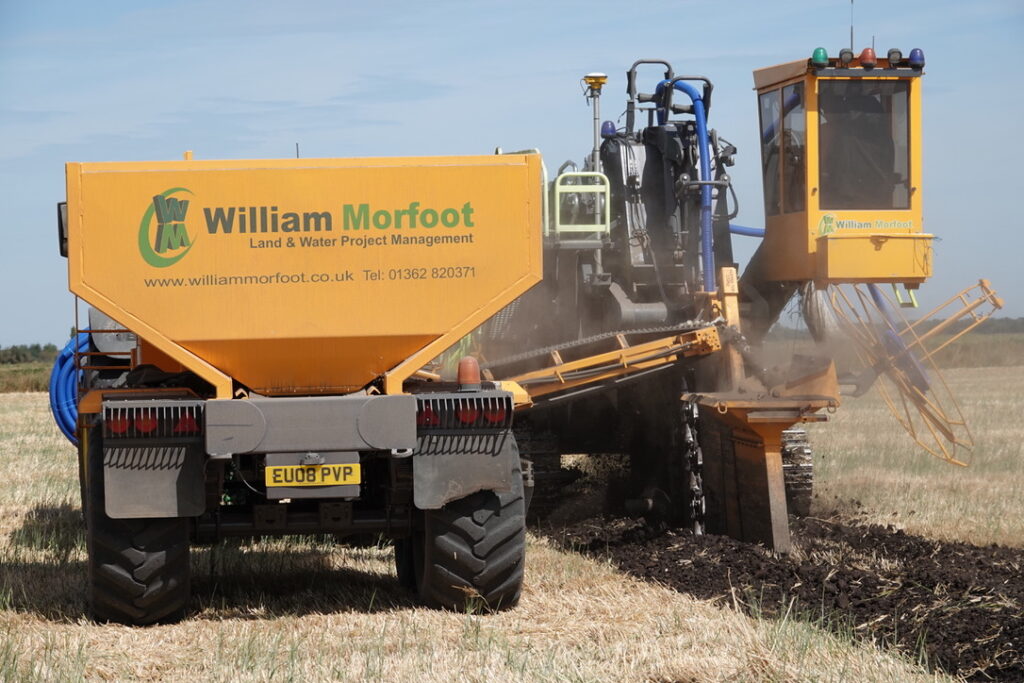
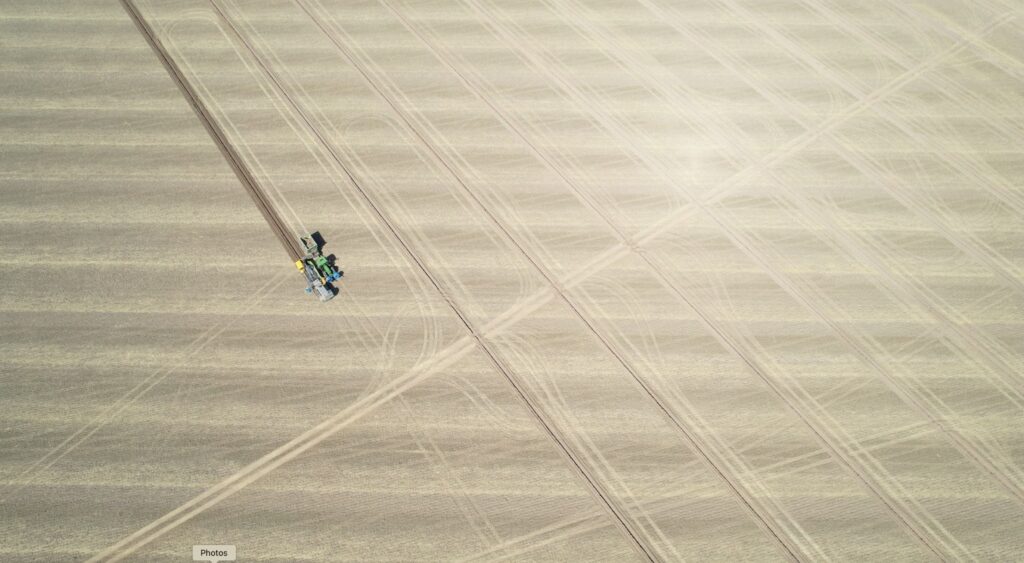
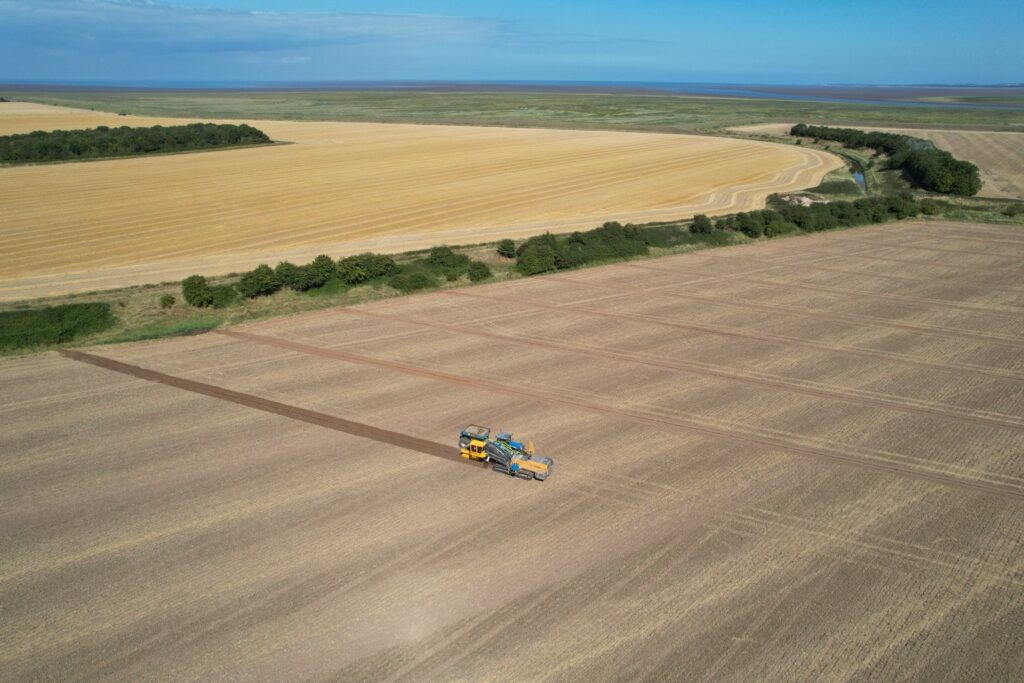
Once the design has been agreed, specialist machinery is used to install agricultural land drainage in the UK, laying the underground pipe network to the agreed specification.
Modern trenchers and drainage machines allow pipes to be installed accurately at the required depth and gradient.
Trenching machines vary greatly in their specification. Some trenching machines go on the back of tractors on the 3 point linkage. Professional contractors tend to use dedicated steel tracked trenching machines with fully automated GPS guidance for drains positioning and grading. As land drainage is generally considered a long term investment, it is typical for landowners to opt to use professional contractors to install major drainage systems as they tend to offer the very best in drainage machinery as well as possessing the necessary expertise to ensure the schemes are correctly installed.
Depending upon the drainage specification and soil conditions, permeable backfill or gravel may also be introduced above the pipe. This can provide an improved pathway for water to move through the soil profile towards the drain.
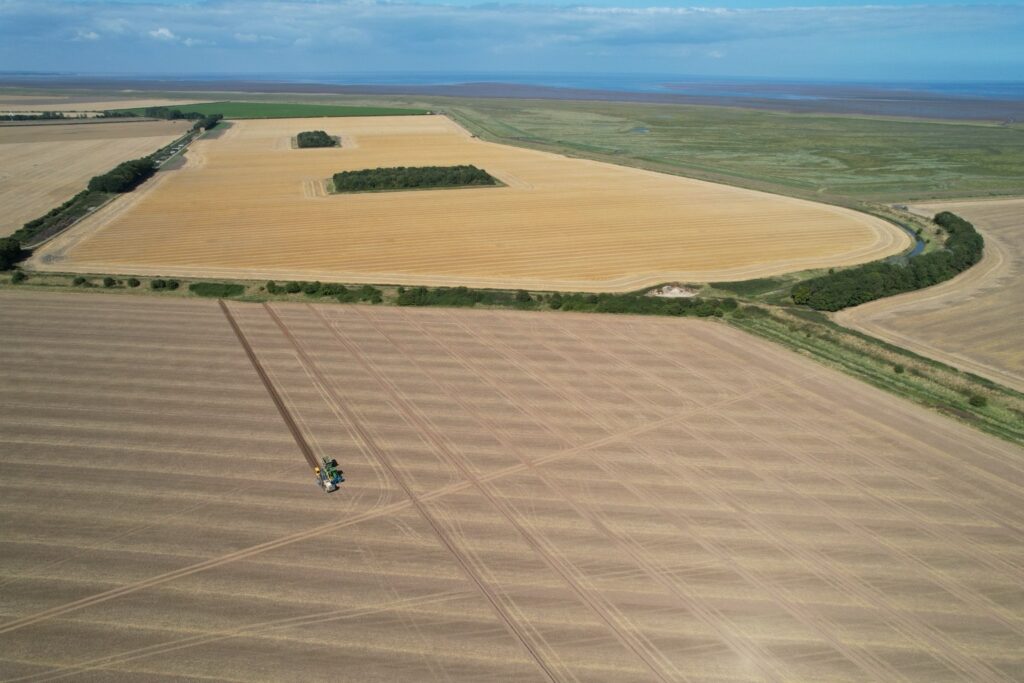
On larger schemes, the scale of the completed system can be substantial. A single field may contain many kilometres of underground drainage pipe arranged systematically to provide consistent drainage across the entire area.
Precision during installation is therefore extremely important.
Small inaccuracies in levels can affect how a drainage system performs, particularly across flatter agricultural land where relatively small changes in elevation can be significant.
This is why dedicated tracked trenching machines are able to install drainage systems with greater accuracy over large areas – even when soils are in wet or unstable condition.
Existing drainage systems: repair or replace?
Agricultural land drainage in the UK already exists on many farms, but a significant proportion of these systems were installed several decades ago. The government provided drainage grants until the early 1980s, and when these grants stopped, so did landowners’ appetite to invest in drainage.
Some older systems continue to perform extremely well. Others may have become less effective because of damaged pipes, sediment, root ingress, blocked outfalls or changes in farming practices.
Drain spacing can also be an issue.
A system designed many years ago may no longer provide the drainage intensity expected from a modern agricultural operation, even where individual pipes remain functional.
Before recommending complete replacement, it can therefore be worthwhile investigating the existing system.
In some circumstances existing drains can be retained, repaired or incorporated into a new design. In others, installing a new systematic drainage system provides the most effective long-term solution.
The correct approach should always be based upon what is happening beneath the field rather than assumptions made from conditions visible at the surface.
Drainage outfalls and ditch maintenance
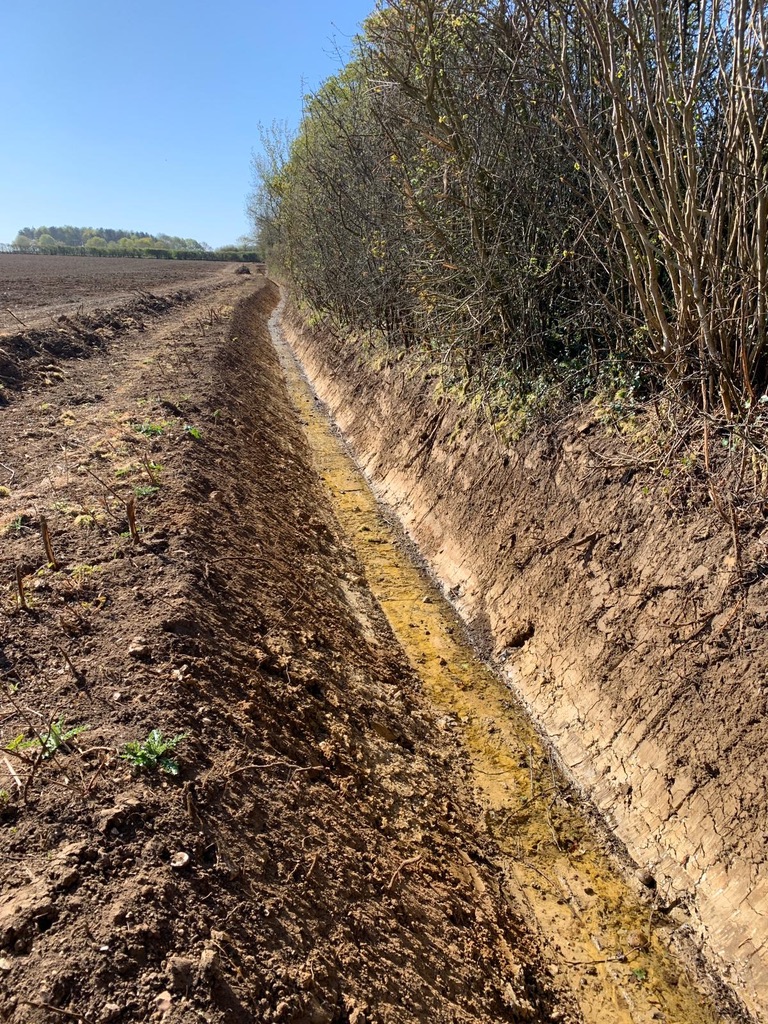
No agricultural land drainage in the UK can work effectively without a satisfactory outfall.
Every litre of water collected by field drains ultimately needs somewhere to discharge.
Ditches and watercourses are therefore a fundamental component of agricultural drainage. If an outfall becomes restricted by vegetation, sediment or bank failure, the performance of the drainage system upstream can be compromised, which may also require consent under land drainage byelaws or an environmental permit from the Environment Agency.

Outfall levels are also crucial when designing new systems.
Understanding both the existing level and the long-term maintenance requirements of the receiving ditch or watercourse should form part of the overall drainage design process.
Land drainage should therefore be regarded as part of a wider water management system, rather than simply a network of underground pipes.
Agricultural drainage as a long-term investment
One of the important characteristics of professionally installed agricultural land drainage in the UK is its longevity.
A correctly designed and installed system can continue working for many decades.
The benefits are therefore realised over numerous cropping cycles and through a wide range of weather conditions.
Improved drainage can contribute towards more uniform crop establishment, improved trafficability, reduced periods of waterlogging and greater flexibility over when field operations can take place.
Perhaps most importantly, drainage helps make agricultural land more resilient to wet weather.
Farmers cannot control rainfall, but good infrastructure can significantly improve how effectively their land responds to it.
When should farmers consider investing in agricultural land drainage in the UK?
The most obvious indication of a drainage problem is standing water, but there are many less dramatic symptoms.
Areas of consistently poorer crop performance, delayed establishment, wet patches, difficult travelling conditions or fields that remain unworkable significantly longer than neighbouring land may all warrant further investigation.
Drainage should also be considered strategically rather than simply as an emergency response to a particularly wet winter.
Surveying fields during different conditions, reviewing historical drainage plans and using knowledge of crop performance can help identify where investment is likely to provide the greatest benefit.
Modern yield mapping and other precision farming data such as satellite imagery can add another valuable layer of information when assessing variations across a field.
Choosing an agricultural land drainage contractor in the UK
Agricultural drainage is designed to remain underground and perform for decades, making experience and installation quality especially important.
When selecting an agricultural land drainage contractor, farmers and landowners should consider surveying and design capability, specialist equipment, operator experience, understanding of different soil types and the contractor’s ability to provide a properly engineered solution rather than simply install pipe. Capacity and the ability to deliver works when needed is also a major factor for many when considering drainage investment.
Established in 1962, William Morfoot Ltd provides agricultural land drainage surveying, design and installation services throughout the UK.
Our approach combines more than six decades of specialist land drainage experience with modern GPS surveying, digital design and specialist installation equipment.

From investigating existing systems and assessing problematic fields through to designing and installing complete new drainage schemes, our objective is simple: to create drainage systems that deliver effective water management and continue benefiting the land for decades to come.
If you are considering land drainage investment or have fields that are consistently affected by excess water, contact William Morfoot Ltd to arrange a drainage survey and discuss the options available.